Upbooks
EnterprisePricingContact
Log inGet Started →
Upbooks
EnterprisePricingContact
Log inGet Started →
Product
Project ManagementAccounting & FinancePOS & SalesInventoryHRCRMQuikBillingCustomer PortalProcurement
4.2
Great•6 reviews
Solutions
Solopreneurs & FreelancersGrowing BusinessesEnterprisesManufacturersRetailLogistics & DistributionOnline-invoicingAccountingExpense ManagementInventory ManagementHR & Payroll SuiteProject ManagementAutomated WorkflowsOnline PaymentsActivity Monitoring & Access LoggingSecure Centralised Document RepositoryAdvanced ReportsEmail Reminders
Resources
BlogDocumentationHelp CenterAPI DocsComparisonDownload IntroAccount & FinanceBoards by UpbooksConstructionCustomers & Sales ManagementEcommerce by UpbooksHRMS by UpbooksLeadTrackr by UpbooksManufacturing and OperationQuikBilling by UpbooksVendors & Purchase Management
Company
AboutCareersContactFAQGetting Started GuideVideo TutorialsPrivacyTermsRefund and Cancellations

© 2026 Upbooks™ — All rights reserved. The new age ERP which is AI-ready. AI-powered business productivity suite.

A productivity suite by Scrrum Labs

Back to Blog
What a mobile app costs after launch: the budget most businesses never plan
Business, Technology, Business Operating System

What a mobile app costs after launch: the budget most businesses never plan

Radhika Mandhar
November 26, 2026
2.5 min read

Tags:

#Mobile App Development#App Maintenance#App Maintenance Cost#Custom Software Development#Mobile Strategy#Business Technology#Software Budgeting#App Store Requirements#Tech Strategy#Software Development India#North America#Asia-Pacific#India#Europe#B2B#B2C#SaaS

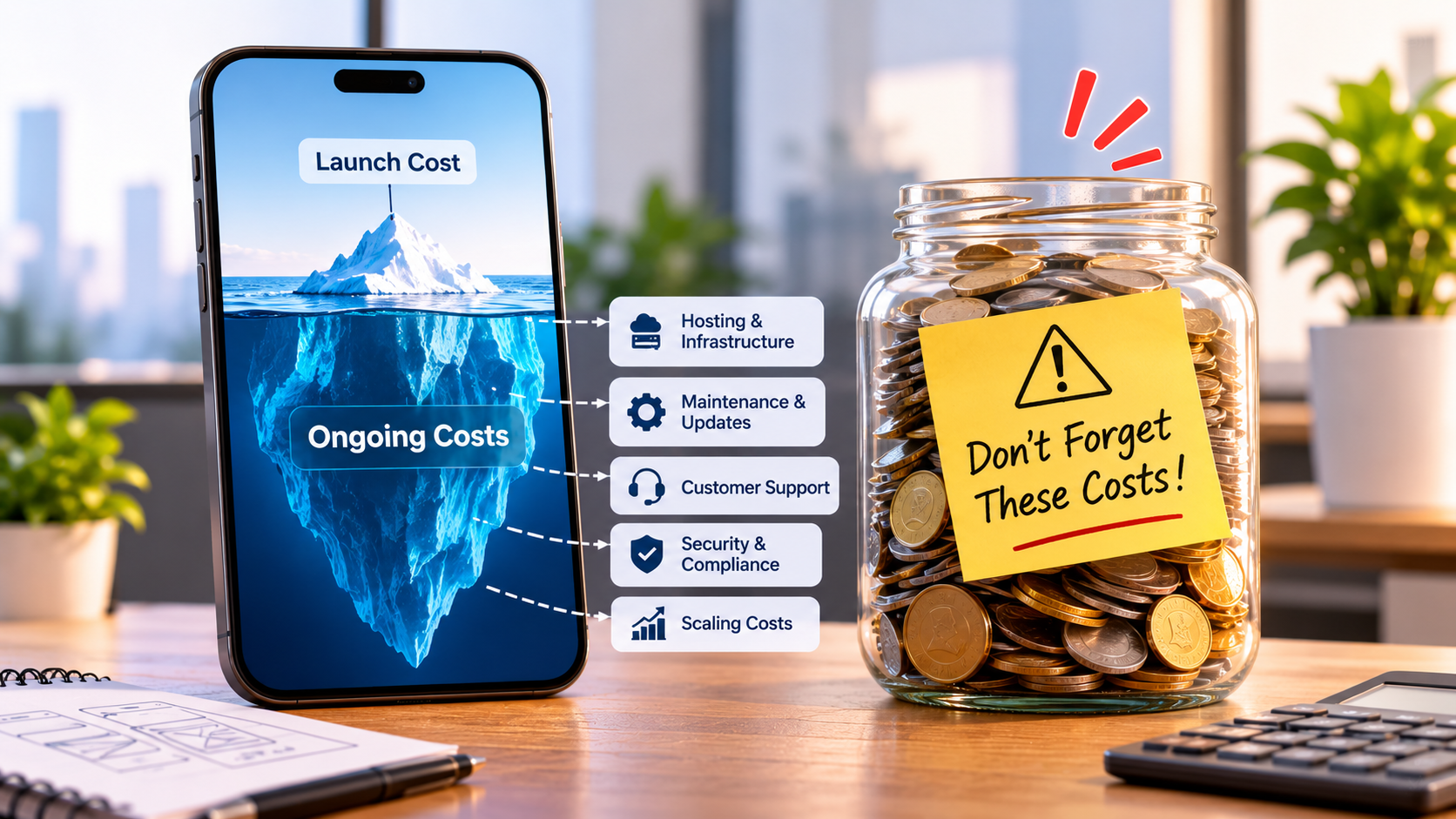
The launch invoice is not the cost of the app. It is the cost of the first version. Most businesses budget carefully for the build, celebrate the release, and then discover that the app has a running cost of its own.

Why this matters now

Two platform rules in 2026 turned a vague future cost into a dated one. Since 28 April 2026, Apple requires every app uploaded to App Store Connect to be built with Xcode 26 or later, using the iOS 26 SDK. From 31 August 2026, Google Play requires new apps and app updates to target Android 16, API level 36.

Neither rule pulls a live app off the store on its own. But an app that has not been touched since launch cannot ship an update to either store until it is rebuilt to the new standard. Even a one-line fix waits. And on Google Play, apps whose target is too old stop being offered to new users on newer phones.

The operating systems keep moving

Apple and Google ship a major release every year. Each one changes how apps behave on a phone, and each needs testing and sometimes code changes. The store rules above are the visible part. The invisible part is a checkout screen that quietly breaks on a new version.

Everything the app leans on keeps moving too

A typical business app depends on a payment gateway, a maps service, an SMS or notification provider, and a backend that stores the data. Each of those updates its own software kit, changes its pricing, or retires old versions. The app has to follow all of them. Hosting costs also grow with usage, which is good news that still arrives as an invoice.

Real users find what testing did not

Indian phones range from flagship devices to budget handsets several years old, on networks that vary by the hour. Once an app is live, crash reports and support messages start telling the team what pre-launch testing could not. Someone has to read them, fix what matters, and release again.

How much to set aside

A commonly quoted benchmark puts annual maintenance at 15 to 20 percent of the original build cost. Cleveroad, citing CISQ, uses that range for small and mid-sized business products. Some agencies say the first year can run much higher, up to 50 percent, because early fixes and operating system updates arrive together.

Compare two businesses that each spent ₹20 lakh on an app. The first sets aside ₹3 to 4 lakh a year. Its app takes the yearly iOS release and the August Android deadline as routine work. The second treats launch as the finish line. Eighteen months later a new iOS version breaks the payment screen, and the team that built the app has moved on.

Fixing it now means relearning the code, upgrading libraries that fell behind, and rebuilding to store rules that have moved on. That usually costs more than the maintenance it skipped, and customers watch the app fail while it happens.

The bottom line

The useful question at the start of an app project is not what it costs to build. It is what it costs to own. Apps that last are planned as products with a running cost, and built so that updates are routine and not rescues. That is where custom software earns its place: as the layer a business can keep changing as phones, stores and customers change around it.


Related Articles

How AI Has Transformed the IT Product-Based Industry
Technology / Artificial Intelligence / Product Development

How AI Has Transformed the IT Product-Based Industry

Artificial Intelligence is no longer a futuristic concept—it is actively reshaping the IT product-based industry. From smarter product development to personalized user experiences, AI is helping companies innovate faster, reduce costs, and stay competitive in a rapidly evolving digital world.

March 26, 20268 min read
SAP ECC Support Ending in 2027: What It Really Means for Indian Businesses
Technology, Business OS

SAP ECC Support Ending in 2027: What It Really Means for Indian Businesses

SAP ECC support ends in 2027. Learn what it means for Indian businesses, ERP transformation, compliance, operational scalability, and future-ready enterprise technology strategy.

May 26, 20268 min read
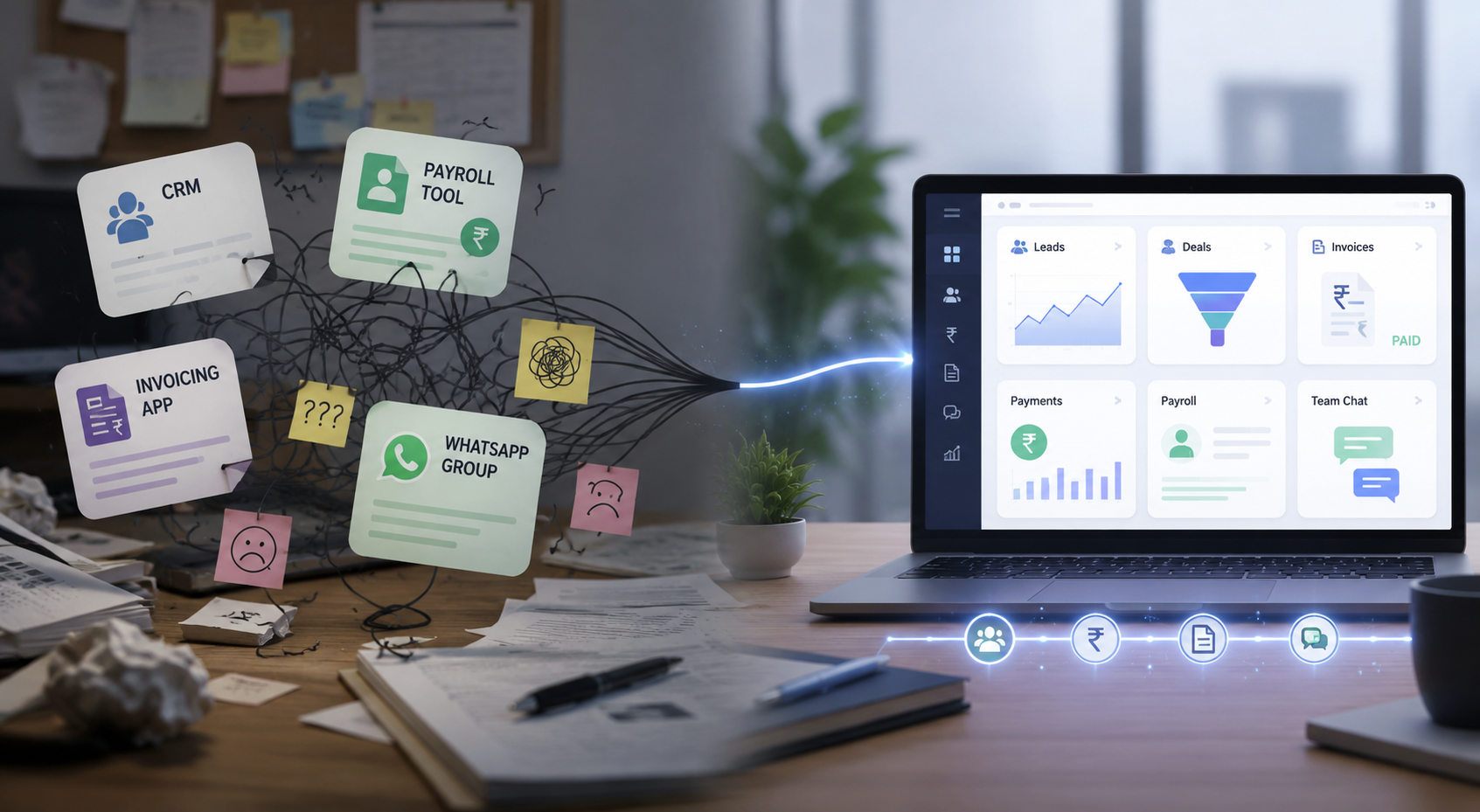
Your Business Has a CRM, a Payroll Tool, an Invoicing App, and a WhatsApp Group. That Is Not a Stack. That Is a Workaround.
Technology

Your Business Has a CRM, a Payroll Tool, an Invoicing App, and a WhatsApp Group. That Is Not a Stack. That Is a Workaround.

Most growing businesses run on a collection of disconnected tools held together by spreadsheets and WhatsApp. This blog names the pattern — tool sprawl — explains how it happens, what it costs in operational drag and slow decisions, and what the right question is before buying anything new.

June 3, 20264 min read

Ready to Transform Your Business?

Discover how Upbooks can help streamline your operations and drive growth.

Start Free TrialContact Sales