Tags:
AI showing up in financial and operational tools isn't optional anymore — it's already embedded in invoicing, forecasting, expense categorization, and reporting across most modern business software. The real question for a business owner isn't whether to use it. It's how much to trust it, and where the line should sit.
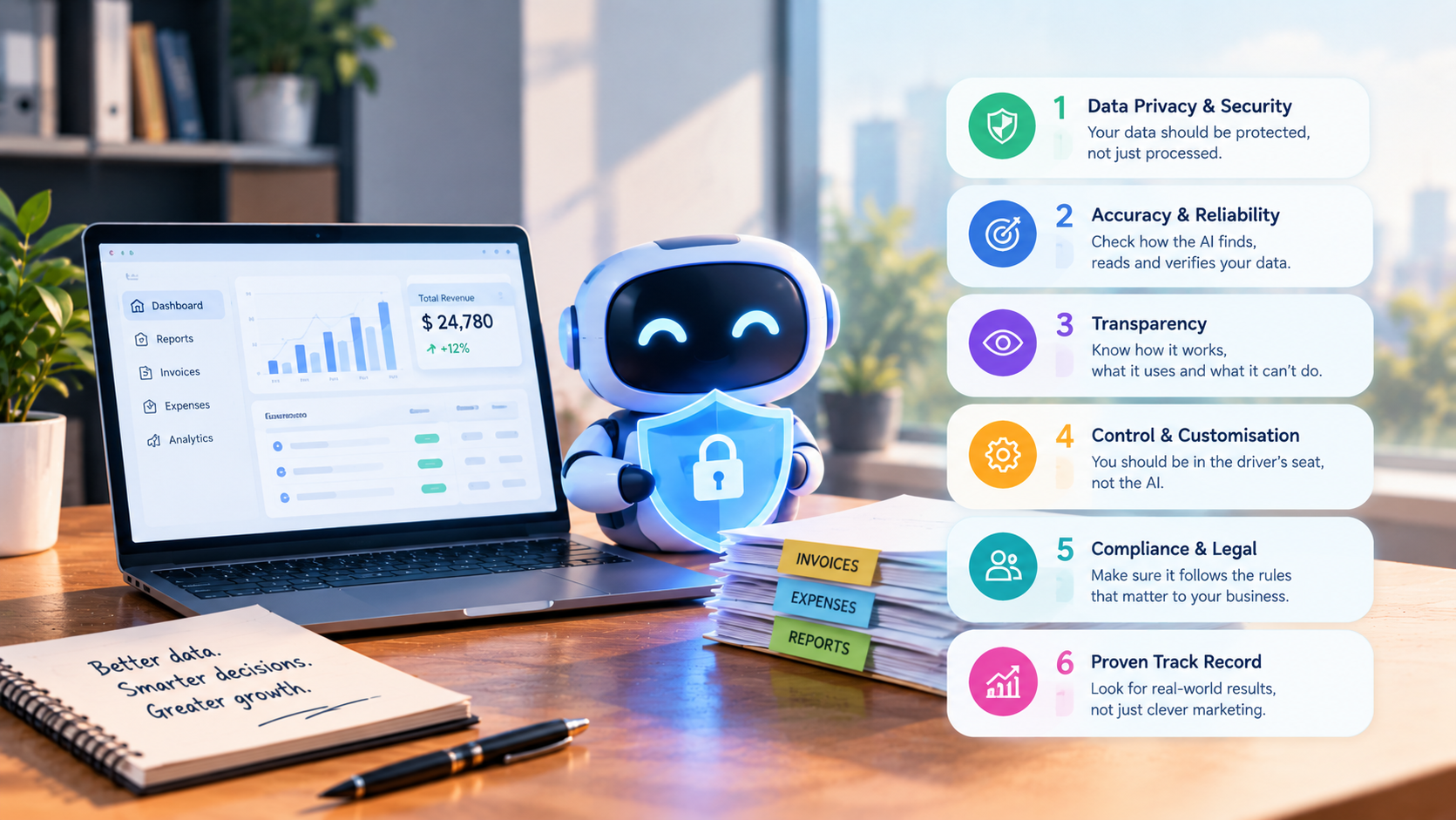
Here are six things worth checking before letting AI make — or influence — a decision that touches your money or your operations.
1. Does it show its reasoning, or just an answer?
A trustworthy AI feature should be able to show why it's suggesting something — this invoice is flagged because the customer paid late twice before, this reorder quantity is based on the last 90 days of sales velocity. A tool that just outputs a confident number with no visible reasoning is harder to sanity-check, and easier to blindly follow into a mistake.
2. Can you see — and override — every automated action?
Automation is only safe if it's reversible and visible. Before trusting any AI-driven action, confirm there's a clear log of what it did and when, and a straightforward way to undo or override it. If an action happens invisibly, with no trail and no easy undo, that's a red flag regardless of how accurate the AI claims to be.
3. Is it working from your actual data, or generic patterns?
There's a real difference between AI that's analyzing your specific invoices, customers, and transaction history, and AI that's making a generic, "statistically typical" recommendation with no visibility into your actual numbers. Ask directly: is this suggestion based on my data, or on general patterns the model learned elsewhere?
4. Does it flag uncertainty, or always sound equally confident?
Good judgment — human or artificial — knows the difference between "I'm fairly sure" and "this is a guess." An AI tool that expresses the same confident tone regardless of how much real data backs a suggestion is harder to calibrate trust around than one that visibly flags low-confidence situations for human review.
5. Does a human still approve anything touching real money?
For anything involving actual financial exposure — a large payment, a significant reorder, a customer-facing communication — a human approval step should sit between the AI's suggestion and the action actually happening. Full autonomy makes sense for low-stakes, repetitive tasks. It makes far less sense for anything with real financial consequences if it goes wrong.
6. What happens when it's wrong?
No AI system is right 100% of the time — the honest question isn't whether it will ever make a mistake, but what happens when it does. Is the error easy to catch? Is it caught before or after it affects a customer or a filing? A tool that makes occasional errors with an obvious, fast recovery path is far more trustworthy than one that's slightly more accurate but harder to catch when it does go wrong.
The bottom line
None of this means AI shouldn't be trusted with financial or operational work — it increasingly can be, and increasingly should be, for the routine, repetitive parts of the job. It means trust should be earned feature by feature, not assumed because a product happens to advertise "AI-powered" somewhere on its homepage.