Tags:
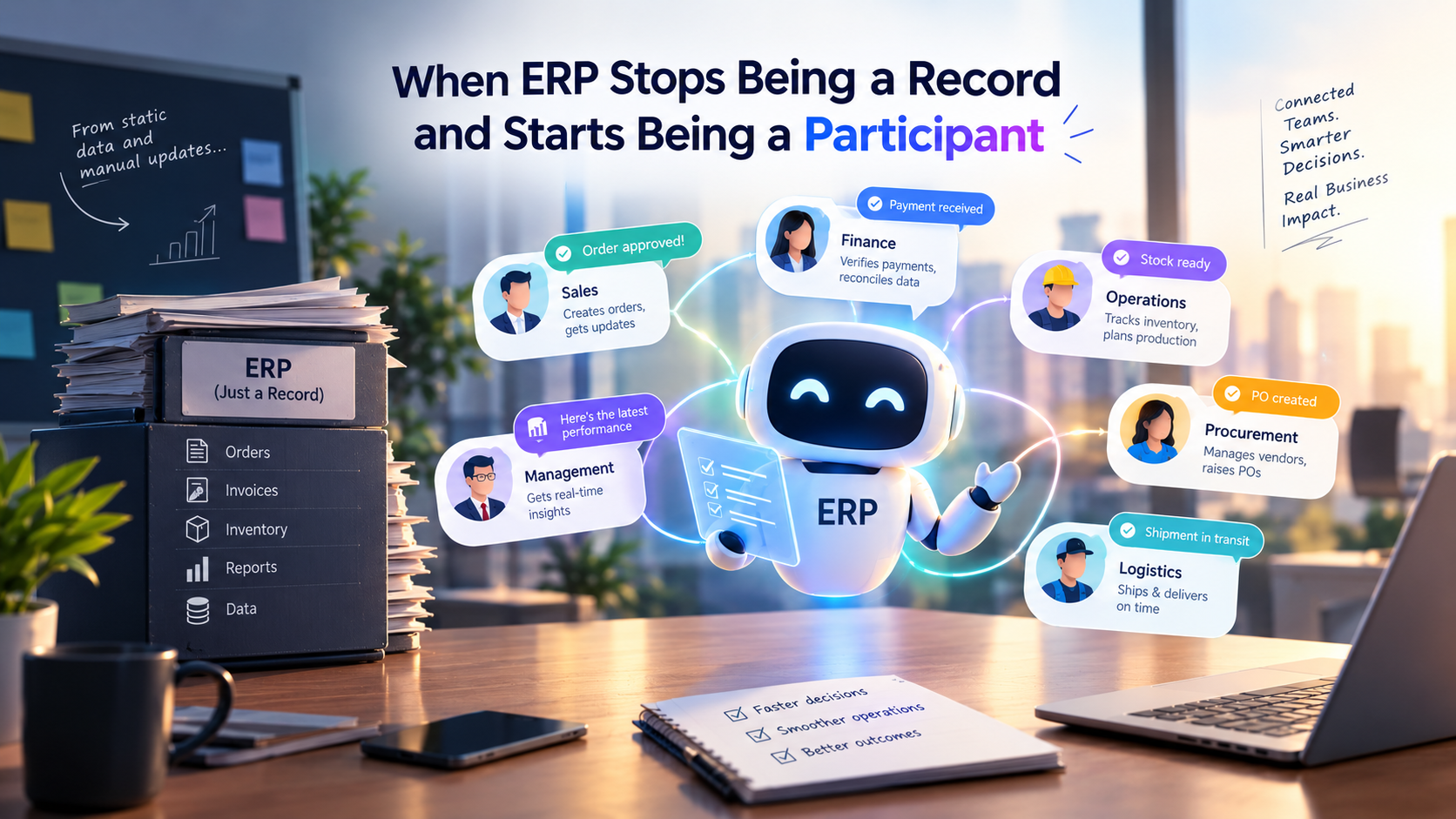
For decades, an ERP system was essentially a very organized filing cabinet. You entered data. It stored data. When you wanted to know something, you ran a report and read it. The system never acted on its own — it waited for a human to look, decide, and instruct it.
That role is starting to change, and the shift has a name analysts are now using: ERX — a system where execution and intelligence are built into the platform itself, not layered on top of it afterward.
From system of record to system of action
The old model can be described in one sentence: humans decide, software records. You'd notice a stock shortage, decide to reorder, and manually create the purchase order. You'd notice a client hadn't paid, decide to follow up, and manually send the reminder. The software was a faithful record-keeper, nothing more.
The emerging model inverts part of that sequence. The system doesn't just store the fact that stock is low — it can flag it, calculate a reorder quantity based on real sales velocity, and draft the purchase order, leaving a human to approve rather than originate the action. It doesn't just record an overdue invoice — it can trigger a reminder automatically, based on rules set once, rather than waiting for someone to notice.
This is the essence of what's meant by "execution and intelligence" working together: analysis and action happening inside the same system, instead of analysis happening in the software and action happening manually, hours or days later, if it happens promptly at all.
Why this is a bigger shift than it sounds
It's tempting to file this under "more automation," as if it's simply a faster version of what ERP already did. It's a more fundamental change than that.
Traditional automation follows fixed rules: if X happens, do Y. It's useful, but rigid — the moment a situation falls slightly outside the predefined rule, the automation stops being helpful and a human has to step back in.
What's emerging now is closer to adaptive judgment. A system that can weigh several signals together — not just "invoice is overdue" in isolation, but overdue and this customer's payment history and whether a renewal conversation is coming up — and adjust its response accordingly, the way a thoughtful employee would, rather than following one rigid script.
That's a genuinely different category of software behavior. It's the difference between a smoke detector that beeps at a fixed threshold, and a system that notices smoke, checks whether anyone's cooking, and decides whether the situation actually warrants an alarm.
What this looks like in a real business
Picture a small distribution business. Under the old model, someone manually checks inventory weekly, cross-references it against upcoming orders, and places purchase orders as needed — a task that eats a few hours every week and depends entirely on someone remembering to do it consistently.
Under this emerging model, the system is already watching. It sees inventory dropping, cross-references upcoming order commitments, checks the pattern of vendor lead times, and either places a routine reorder automatically or flags a decision for a human when something's unusual — a sudden demand spike, a vendor delay, a cash flow constraint that makes it worth pausing before repurchasing.
The person hasn't been replaced. Their attention has been redirected — away from the routine 90% of cases that don't need a human decision, and toward the 10% that genuinely do.
The trust question this naturally raises
Understandably, this raises a fair concern: how much should a business actually let a system act on its own? The honest answer is that this isn't, and shouldn't be, all-or-nothing.
The systems being built around this idea are generally designed with clear boundaries — routine, low-risk actions can run automatically, while anything touching real money, contractual terms, or customer relationships gets flagged for a human decision rather than executed outright. The goal isn't a system nobody supervises. It's a system that knows the difference between "handle this" and "ask first" — and gets that distinction right consistently enough to actually be trusted with the first category.
That distinction — knowing what to act on versus what to escalate — is arguably the real engineering challenge behind this entire shift, more than the underlying AI models themselves.
Why this matters even for a small business
It's easy to assume this kind of capability is an enterprise-scale conversation — something for companies with dedicated operations teams and six-figure software budgets. That's becoming less true. The economics of building intelligence into software have shifted enough that these capabilities are increasingly showing up in tools built for much smaller businesses, not just large enterprises with dedicated implementation teams.
For a small business specifically, the value proposition is arguably sharper than it is for a large one. A large company can absorb the cost of someone manually checking inventory every week. A five-person operation often can't spare that time at all — which means a system that quietly handles the routine 90% isn't a nice-to-have efficiency gain. It's the difference between that task happening consistently, or happening only when someone remembers.
The real shift to understand
The interesting part of this trend isn't that software got smarter in some abstract sense. It's that the boundary between "the system that stores information" and "the system that acts on it" is dissolving. For most of ERP's history, that boundary was the whole point — data lived in one place, decisions happened in someone's head.
That separation is no longer a given. And the businesses that benefit most from this shift won't be the ones with the most advanced AI. They'll be the ones whose systems have enough context — enough connected, accurate, real-time data — to make that blurred boundary actually trustworthy, rather than reckless.