Tags:
Open your invoicing tool. It has an AI assistant now.
Open your CRM. Also has one.
Open your project tracker. Same thing.
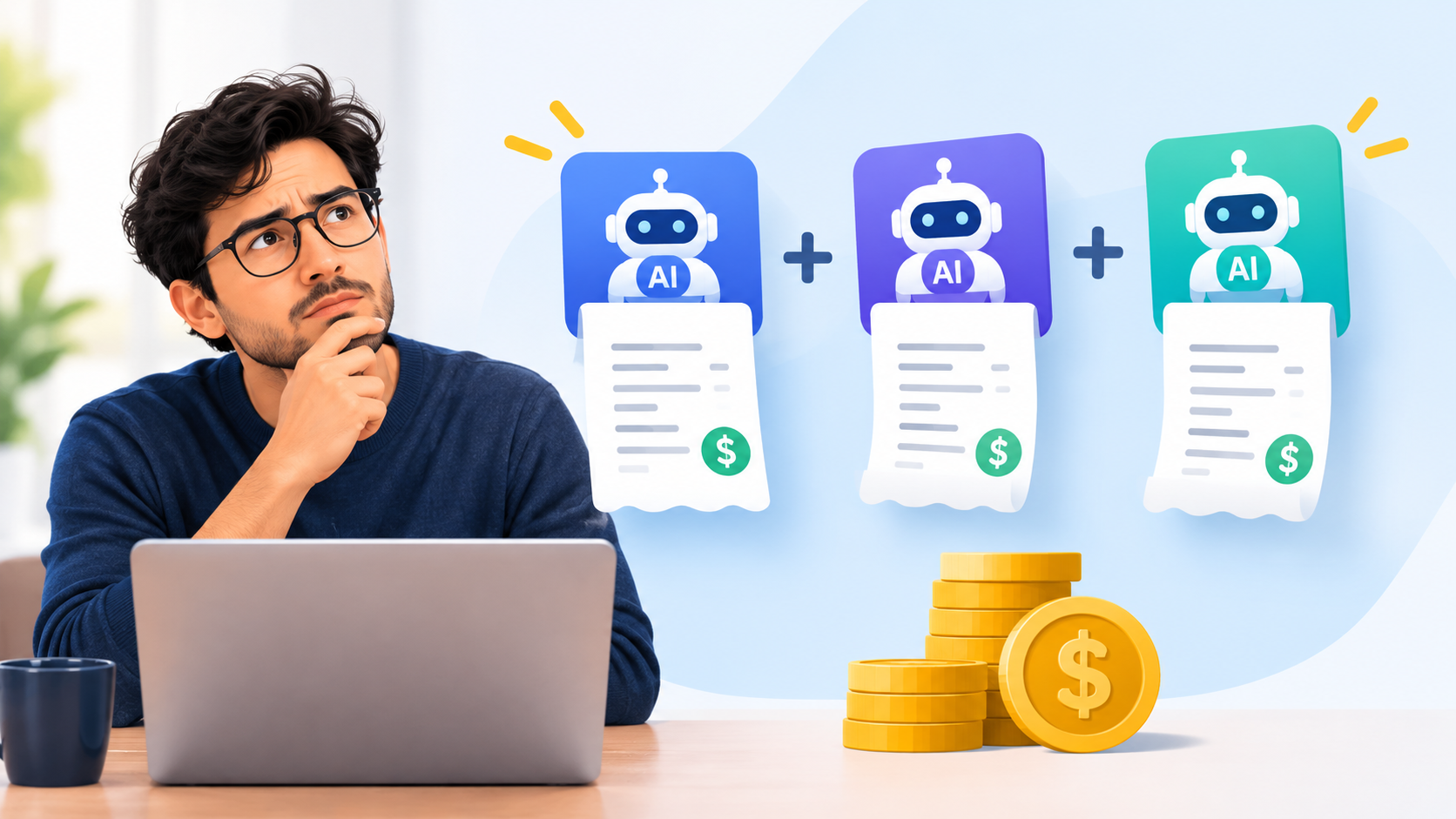
Three different tools, three different AI features, three separate line items on three separate bills. And here's the part nobody points out: all three are doing roughly the same kind of work.
This isn't a hypothetical. It's the default state of almost every small business's tech stack in 2026. Somewhere along the way, "AI-powered" became a checkbox every SaaS product had to tick, whether or not it made the product genuinely better. So each tool bolted one on. And most businesses ended up collecting several versions of the same basic capability without ever noticing.
The redundancy hiding in plain sight
Think about what these AI features actually do, stripped of their marketing language. Your invoicing app's AI drafts a payment reminder. Your CRM's AI suggests which lead to follow up with first. Your project tool's AI summarizes a thread you missed while you were away. Your expense tracker might even have one now that auto-categorizes a receipt.
Each of these, described plainly, is doing one of two things: recognizing a pattern in some data, or generating some text based on that pattern. That's it. That's the trick behind most "AI-powered" features being sold today. It's a genuinely useful trick — but it's the same trick, rebuilt from scratch inside every tool you use, and billed to you separately every time.
If you added it up — what you're actually paying, across every subscription, specifically for the "AI" line item — most business owners would be surprised by the number. Not because any single fee is unreasonable, but because so many of them are quietly funding the same basic function, again and again, in isolation.
Why this isn't really about the money
The extra cost is real. But it's not actually the biggest problem here. The bigger issue is what all of that spending fails to produce.
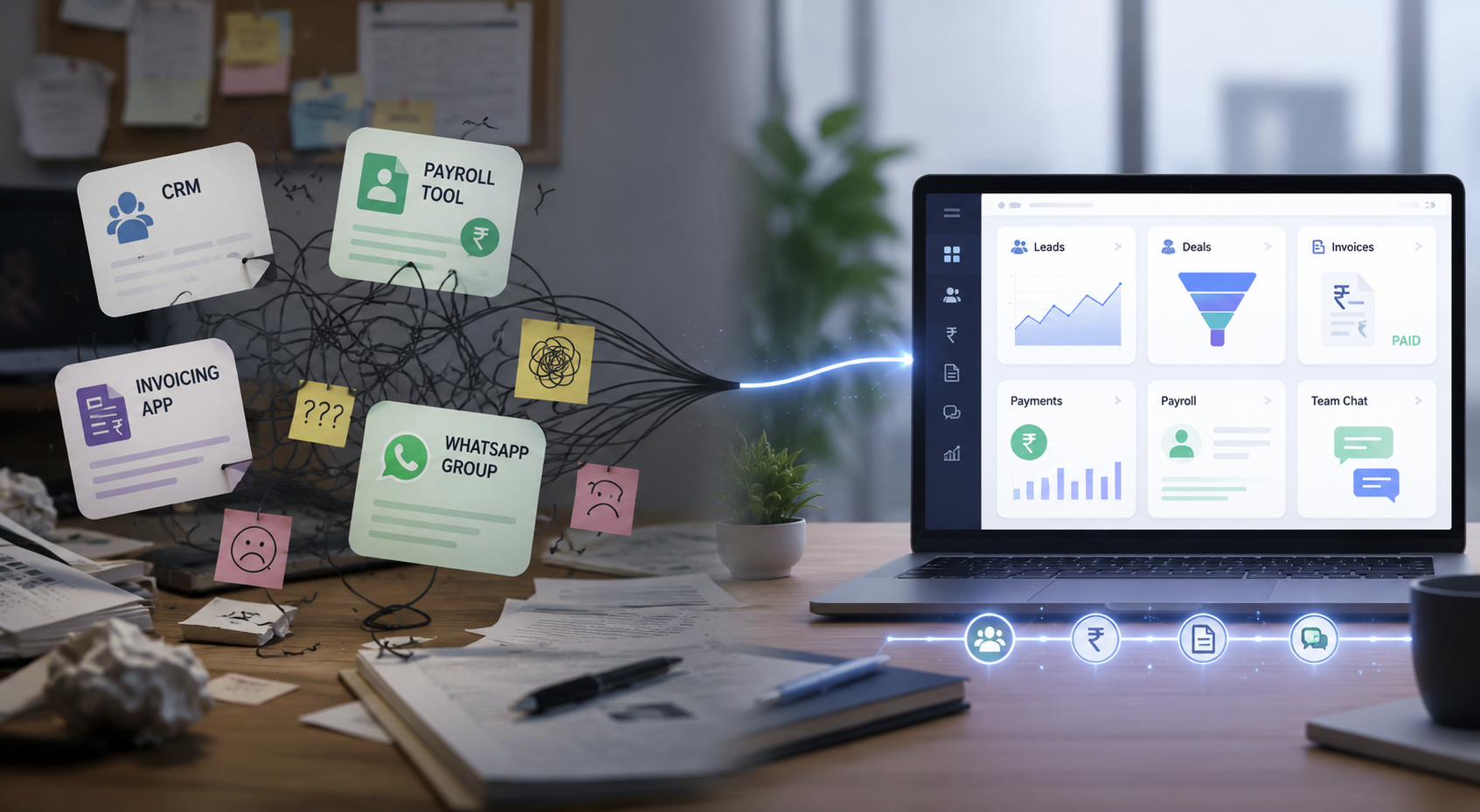
Your invoicing AI doesn't know a particular customer is historically a slow payer, because that information lives in your CRM, not your invoicing tool. Your project management AI can't factor in that a client's payment just went overdue, because it has no visibility into your billing system at all. Your CRM's "smart" lead scoring doesn't know that a top prospect's last three projects with you ran late and over budget — because that history sits inside your project tracker, a completely separate silo.
Each of these AI features is smart in exactly one narrow context, and blind everywhere else. Not because the underlying AI is weak — the AI itself is often genuinely capable — but because it was only ever given access to one slice of the business. A tool can't reason about something it was never shown.
So you end up in a strange position: three, four, sometimes five tools, each proudly "AI-powered," and yet no single one of them can answer a question that spans more than its own four walls. You have more intelligence than you did five years ago, and somehow it adds up to less insight than one person who's been paying close attention across the whole business.
What it would look like done differently
Imagine, instead, one AI that could actually see leads, invoices, and project timelines together — not three separate assistants, each squinting at their own narrow slice of the picture.
That AI could tell you something none of your current tools can: this customer's project is running behind, their last invoice is nine days overdue, and they've got a renewal conversation scheduled for next week — maybe that's not the week to push the renewal without addressing the delay first. No single-app AI assistant can put that sentence together, because no single app has all three pieces of information at once.
That's the real difference between "AI-powered" and actually intelligent. It's not about which tool has the flashier chatbot. It's about whether the AI can see enough of the business to say something genuinely useful, instead of something narrowly correct but practically incomplete.
The trap of buying AI feature by feature
Part of why this redundancy happens so easily is that AI features get evaluated one tool at a time. When you're choosing a CRM, you compare its AI capabilities to other CRMs. When you're choosing an invoicing tool, you do the same thing in that category. At no point does anyone step back and ask: across everything I'm already paying for, how many of these AI features are actually solving different problems, and how many are quietly overlapping?
Most businesses would never deliberately buy the same feature three times. But that's effectively what happens when every tool in a fragmented stack adds its own isolated AI layer, and nobody ever adds it all up.
A simple filter going forward
Next time a tool pitches you its AI feature — in a sales call, a product update, a "new: now with AI!" email — it's worth pausing on one question before comparing price or polish:
Does this AI only see what's inside this app, or does it see my business?
If the honest answer is "only this app," you're not really buying intelligence. You're buying a slightly smarter version of a single silo, dressed up in the same language as everyone else's AI feature, and paying full price for it — quite possibly right alongside two or three other tools doing almost exactly the same thing, just in a different corner of your business.
The promise of AI for a small business was never supposed to be "every tool gets a little smarter in isolation." It was supposed to be a business that finally has one place where the full picture comes together. Most companies are still paying for the former while waiting for the latter to show up on its own.
It won't. Not until the tools themselves are connected enough to share what they know.