Upbooks
ResourcesEnterprisePricingContact
Log inGet Started →
Upbooks
ResourcesEnterprisePricingContact
Log inGet Started →
Product
Project ManagementAccounting & FinancePOS & SalesInventoryHRCRMQuikBillingCustomer PortalProcurement
4.2
Great•6 reviews
Solutions
Solopreneurs & FreelancersGrowing BusinessesEnterprisesManufacturersRetailLogistics & DistributionOnline-invoicingAccountingExpense ManagementInventory ManagementHR & Payroll SuiteProject ManagementAutomated WorkflowsOnline PaymentsActivity Monitoring & Access LoggingSecure Centralised Document RepositoryAdvanced ReportsEmail Reminders
Resources
BlogDocumentationHelp CenterAPI DocsComparisonDownload IntroAccount & FinanceBoards by UpbooksConstructionCustomers & Sales ManagementEcommerce by UpbooksHRMS by UpbooksLeadTrackr by UpbooksManufacturing and OperationQuikBilling by UpbooksVendors & Purchase Management
Company
AboutCareersContactFAQGetting Started GuideVideo TutorialsPrivacyTermsRefund and Cancellations

© 2026 Upbooks™ — All rights reserved. The new age ERP which is AI-ready. AI-powered business productivity suite.

A productivity suite by Scrrum Labs

Back to Blog
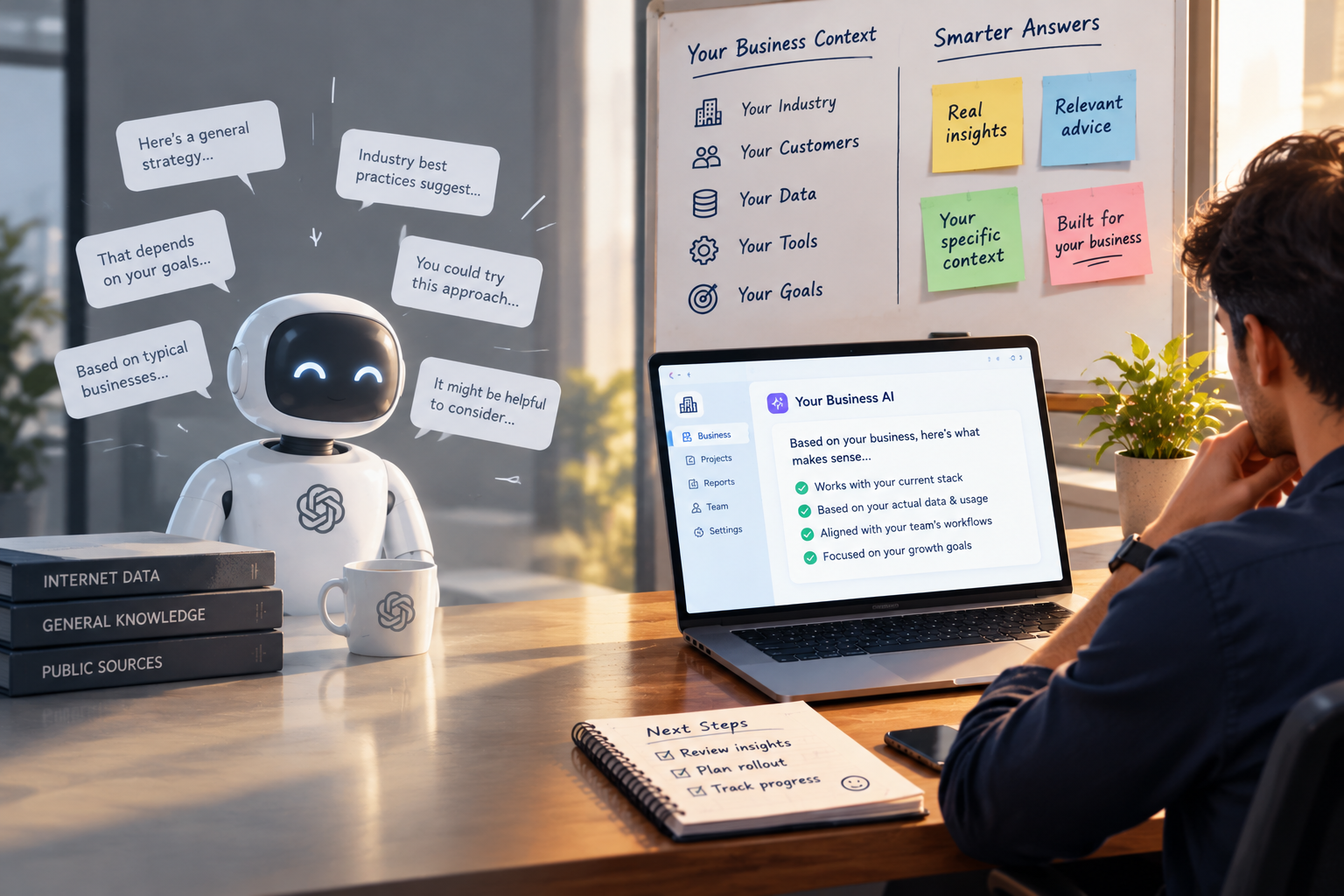
Your AI Doesn't Know Your Business. It Just Sounds Like It Does.
Business, Technology, Business Operating System

Your AI Doesn't Know Your Business. It Just Sounds Like It Does.

Radhika Mandhar
October 12, 2026
5 min read

Tags:

#Artificial Intelligence#AI for Business#Data-Driven Decisions#Small Business Technology#AI Limitations#North America#Asia-Pacific#India#Europe#B2B#B2C#SaaS

Ask an AI assistant "which of my customers should I follow up with this week," and it'll give you an answer. Confident. Well-structured. Sounds like good advice.

Here's the catch: it has no idea who your customers are.

The illusion of knowing

Most AI tools today are trained on enormous amounts of general knowledge — articles, books, forums, code, everything on the open internet. That makes them genuinely excellent at language, reasoning, and sounding informed.

What it doesn't make them is informed about you.

When you ask a general AI something about your business, it isn't wrong exactly — it's just answering from what "usually" makes sense, not from what's actually happening in your business. It'll tell you to follow up with high-value leads. It won't tell you which three customers have invoices sitting unpaid for ten days, or whose last order was two months ago and hasn't reordered since.

One of those answers sounds smart. The other one is actually useful.

Smart vs. informed — not the same thing

Think of it like asking a very well-read stranger for advice about your business, versus asking someone who's actually looked at your books.

The stranger might say something reasonable: "prioritize your best customers, follow up on overdue payments, watch your slow-moving stock." All true. All generic. None of it tells you what to do today.

Someone who's actually looked at your real numbers gives you something different: these three customers specifically, this vendor specifically, this stock item specifically — because they can see what's actually going on, not just what's typical.

That's the real difference between AI that sounds smart and AI that's actually useful. Smart is about language. Useful is about data.

Why this matters more for a small business

In a large company, a generic AI recommendation gets caught. Someone reviews it, cross-checks it against real numbers, and either uses it or throws it out.

A small business usually doesn't have that layer. If the owner or a small team is relying directly on an AI's suggestion, a fluent but generic answer can easily get mistaken for a good one — because it sounds right. That's a quiet, easy way to waste a week chasing the wrong customer, restocking the wrong item, or deprioritizing something that actually needed attention.

The risk isn't that AI gives bad advice. It's that generic advice, delivered confidently, is hard to tell apart from advice that's actually grounded in your reality.

The question worth asking

Before trusting any AI-generated recommendation for your business, there's one simple filter worth applying:

What is this actually based on — general knowledge, or my real data?

If the answer is "general knowledge," treat it as a starting point, not a decision. If it's working from your actual numbers — your actual customers, your actual invoices, your actual stock — that's a different kind of answer altogether.

The smartest-sounding AI in the world still can't tell you something it was never shown.


Related Articles

Agentic AI: Powering the Next Generation of Autonomous Intelligence
Artificial Intelligence

Agentic AI: Powering the Next Generation of Autonomous Intelligence

Agentic AI is transforming the future of artificial intelligence by enabling systems to act autonomously, make decisions, and achieve goals with minimal human intervention. In this blog, we explore what Agentic AI is, how it works, its key components, real-world use cases, benefits, challenges, and why it represents the next major evolution in AI technology.

January 6, 20265 min read
How AI Has Transformed the IT Product-Based Industry
Technology / Artificial Intelligence / Product Development

How AI Has Transformed the IT Product-Based Industry

Artificial Intelligence is no longer a futuristic concept—it is actively reshaping the IT product-based industry. From smarter product development to personalized user experiences, AI is helping companies innovate faster, reduce costs, and stay competitive in a rapidly evolving digital world.

March 26, 20268 min read
SAP ECC Support Ending in 2027: What It Really Means for Indian Businesses
Technology, Business OS

SAP ECC Support Ending in 2027: What It Really Means for Indian Businesses

SAP ECC support ends in 2027. Learn what it means for Indian businesses, ERP transformation, compliance, operational scalability, and future-ready enterprise technology strategy.

May 26, 20268 min read

Ready to Transform Your Business?

Discover how Upbooks can help streamline your operations and drive growth.

Start Free TrialContact Sales