June 2026
Blog posts from June 2026
The Upbooks blog covers practical guidance for running a modern business on an AI-ready ERP — from invoicing, inventory, and payroll to CRM, project management, and industry-specific operations. Whether you are evaluating software, migrating from spreadsheets, or scaling across teams and locations, these articles are written to help you make clearer decisions and get more from your stack.
Browse by category or archive to find posts on accounting best practices, hospitality and retail workflows, automation with Zapier, API integrations, compliance, and product updates. New articles are added regularly for founders, finance leaders, operations teams, and developers building on Upbooks.
Categories
7 articles found

The Cost of Onboarding Someone Into a Business That Runs on Tribal Knowledge
Most businesses run on knowledge that exists only in people’s heads, passed informally from one employee to the next, drifting slightly with each handover. This blog names the pattern — institutional improvisation — and traces its real cost through onboarding delays, quality failures, and retention problems across three different industries.

Five Things About ERP in 2026 That Most Businesses Have Not Caught Up With
Most business owners are working with a decade-old definition of ERP — long implementations, high costs, enterprise-only scope. This micro-read breaks down five things that have actually changed by 2026, from implementation timelines to AI-assisted reporting.
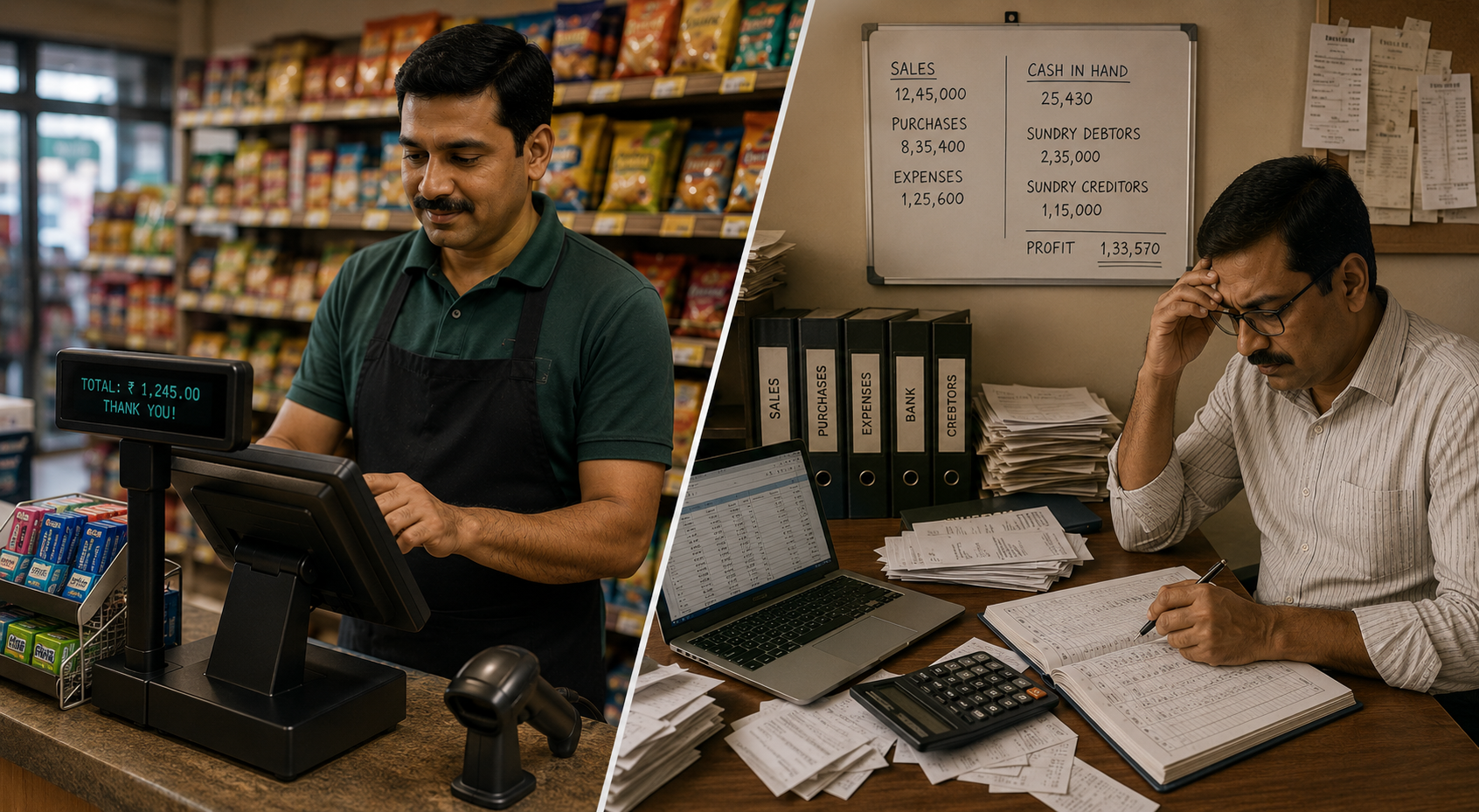
Why Indian retail businesses are running POS and accounts as two separate businesses
Most Indian retail businesses run their point of sale and their accounts as two separate systems, reconciled manually, always out of sync. This blog identifies five reasons that separation is costing retailers more than they realise — from daily reconciliation overhead to real-time visibility gaps — and what an integrated retail operation actually looks like.

The Hiring Process Nobody Built — How SMBs Manage Talent Without a System and What It Costs Them
Most SMBs treat every hire as a one-off event. No defined stages, no shared pipeline, no documented criteria. This blog names the pattern — talent improvisation — traces how it happens across real business scenarios, and reframes the true cost of hiring without a process in financial and operational terms.

Inventory That Lives in Someone’s Head: Why Stock Visibility Is the First Thing Manufacturers Lose When They Grow
When manufacturing businesses grow, the person who carried the inventory picture in their head is no longer enough. This blog identifies four reasons stock visibility breaks under growth, the compounding cost of inaccurate inventory data, and what a connected inventory system looks like compared to the manual approach most mid-sized manufacturers are still running on.

Your Business Has a CRM, a Payroll Tool, an Invoicing App, and a WhatsApp Group. That Is Not a Stack. That Is a Workaround.
Most growing businesses run on a collection of disconnected tools held together by spreadsheets and WhatsApp. This blog names the pattern — tool sprawl — explains how it happens, what it costs in operational drag and slow decisions, and what the right question is before buying anything new.