Tags:
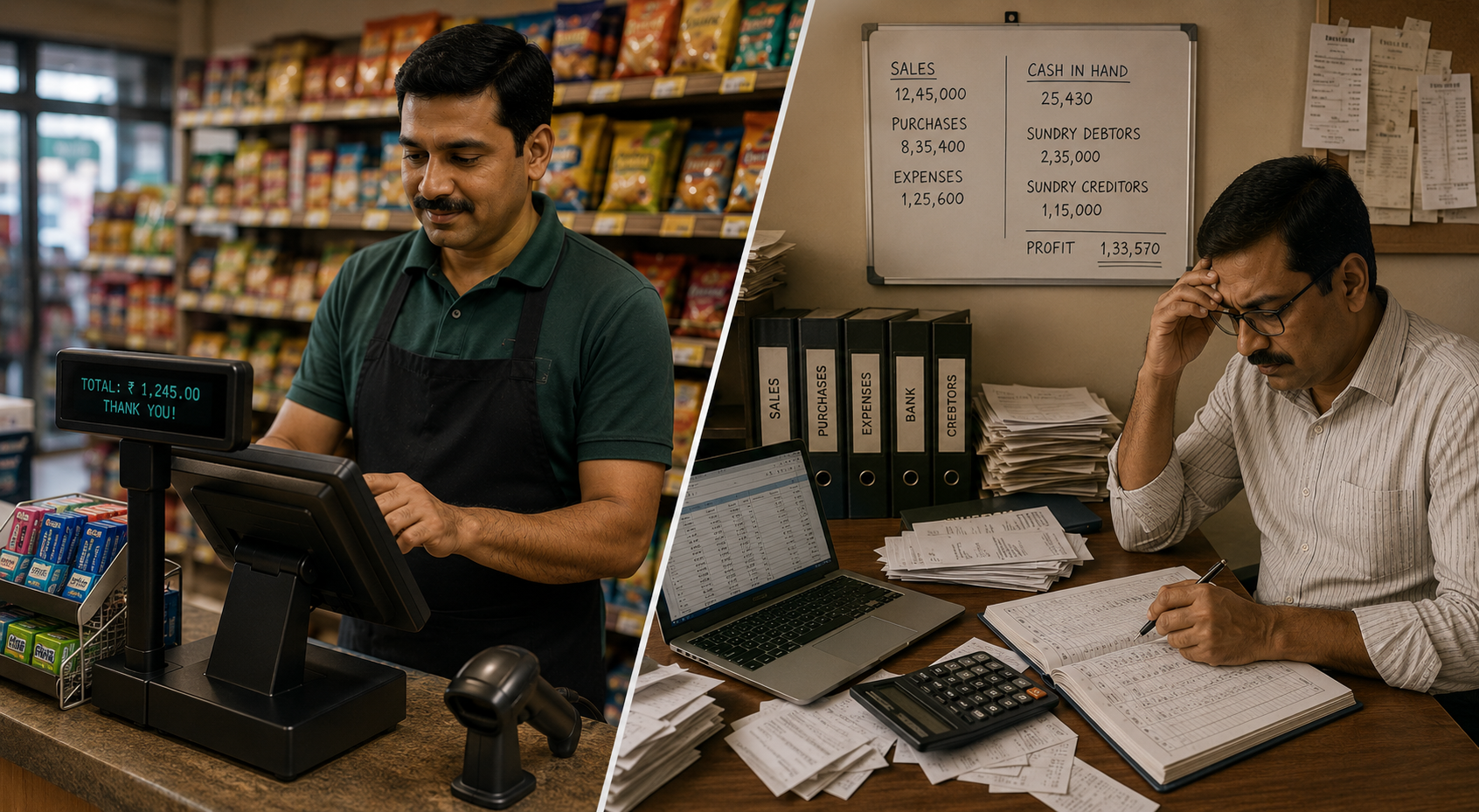
A retail business that cannot see its sales and its finances in the same place is not running one business. It is running two, badly, in parallel. Most Indian retail businesses are doing exactly this.
Why This Matters Now
Indian retail is at an inflection point. The formalisation push driven by GST, the rapid growth of organised retail beyond metros, and the rise of omnichannel operations have all increased the operational complexity facing mid-sized retailers. A business that once ran a single store with a cash register and a monthly accountant visit now manages multiple locations, online orders, loyalty programmes, staff commissions, and real-time GST reporting simultaneously.
The tools that served the single-store era have not kept pace. Most retailers adopted a POS system to manage billing and a separate accounting package to manage books. At the time, that made sense. Today, the gap between those two systems is generating daily operational cost that most retailers have not stopped to calculate.
Five Reasons the POS-Accounts Split Is Costing Indian Retailers More Than They Realise
1. Sales data and financial data are always out of sync
When POS and accounts are separate systems, the sales that happen today do not appear in the books until someone manually transfers the data. That transfer might happen daily, weekly, or monthly depending on the business. In the meantime, the financial picture is always behind the operational reality.
A retailer making three hundred transactions a day across two locations is generating data that needs to be reconciled manually before it means anything financially. The person doing that reconciliation is spending time that could be spent on something else. The reconciliation itself is a source of error. And the financial reports that result from it are always historical by the time they are read.
Busy retail seasons make this worse. During Diwali or an end-of-season sale, transaction volumes spike exactly when the team has the least capacity to manage manual data transfer. The books fall further behind at the moment when accurate financial visibility matters most.
2. Inventory sits in a third blind spot
Most retail POS systems track what was sold. Most accounting systems track what was purchased. Neither one automatically tells the retailer what they currently have in stock, across all locations, updated in real time.
The result is a third data layer that has to be managed separately — either through a standalone inventory system or through periodic manual stock counts. A retailer with five hundred SKUs across three locations running a stock count once a month is making replenishment and buying decisions on data that is weeks out of date.
Zoho Inventory and similar tools address part of this problem but they add another integration point rather than solving the underlying fragmentation. Every additional system is another place where data can diverge, another reconciliation task, and another source of operational drag.
3. GST compliance becomes a manual exercise at scale
GST requires retailers to report sales accurately, categorised correctly, across every transaction. When POS and accounts are disconnected, GST data has to be extracted from the POS, verified against the accounts, reconciled where they differ, and then filed. At low transaction volumes this is manageable. At high volumes it becomes a significant monthly exercise that consumes finance team time and creates compliance risk wherever the reconciliation is imperfect.
The businesses most exposed to this are multi-location retailers where each store runs its own POS and the consolidation happens centrally. The more locations, the more data sources, the more reconciliation steps, and the higher the risk of a filing that does not accurately reflect the actual sales position.
4. The owner cannot see the business in real time
The fundamental purpose of a retail management system is to give the owner a clear picture of how the business is performing at any given moment. Sales, margins, stock levels, top-performing products, slow-moving inventory — all of it, current, in one place.
When POS and accounts are separate, that picture does not exist in real time. It exists as a report assembled after the fact by someone who has pulled data from multiple sources and put it together manually. By the time the owner sees it, the business has moved on. The decision about which products to promote, which supplier to pay first, which location is underperforming — all of it is being made on information that is already out of date.
Retailers using platforms like Posist or GoFrugal have better POS functionality than those on legacy systems, but without native accounting integration, the real-time financial picture is still missing. The operational data and the financial data remain in separate worlds.
5. Multi-location retail makes the problem exponential
A single-location retailer managing POS and accounts separately has a reconciliation problem. A five-location retailer has five reconciliation problems, each feeding into a consolidation exercise that has to happen before anyone can see the business as a whole.
Every location adds another data source, another set of daily transactions, another POS report that has to be matched against accounts, and another opportunity for the two systems to tell a different story. The management overhead of running the finance function across multiple locations without integrated systems scales faster than the business itself.
This is the point at which most multi-location retailers either hire more finance staff to manage the manual workload or accept that their financial visibility will always lag their operational reality. Neither is the right answer.
Disconnected POS and Accounts vs Integrated Retail System
Sales to accounts flow Disconnected: Manual transfer. Daily, weekly, or monthly depending on capacity. Integrated: Automatic. Every transaction updates the books in real time.
Inventory visibility Disconnected: Separate system or manual count. Always historical. Integrated: Live stock position updated with every sale and purchase.
GST compliance Disconnected: Manual reconciliation between POS data and accounts before filing. Integrated: GST data captured accurately at point of sale. Filing is a report, not an exercise.
Financial reporting Disconnected: Assembled manually. Always behind the current position. Integrated: On-demand. Current sales, margins, and cash position available at any time.
Multi-location management Disconnected: Each location managed separately. Consolidation is a manual exercise. Integrated: Single view across all locations. No consolidation required.
Owner visibility Disconnected: Dependent on when the last reconciliation was done. Integrated: Real time. The business is visible whenever the owner wants to look.
Readiness Checklist
Your retail business needs an integrated system if any of these apply:
• Your POS data and your accounts are updated by different people at different times
• You do not know your current stock position across all locations without making calls or running a manual count
• Your GST filing requires a reconciliation exercise between your sales system and your accounts
• You cannot see today’s sales and today’s margin in the same place without waiting for a report
• You are running more than one location and managing each store’s finances separately
• Your buying and replenishment decisions are based on stock data that is more than a week old
• You have ever discovered a discrepancy between what your POS says you sold and what your accounts say you received
If more than two of these are true, the separation between your POS and your accounts is an active cost to the business, not just an inconvenience.
Running POS and accounts as separate systems made sense when retail was simpler. It does not make sense now. The businesses that are winning in organised Indian retail are not the ones with the most locations or the biggest marketing budgets. They are the ones that can see their entire operation clearly, in real time, and make decisions faster than the businesses that are still waiting for last week’s reconciliation to come in.