Tags:
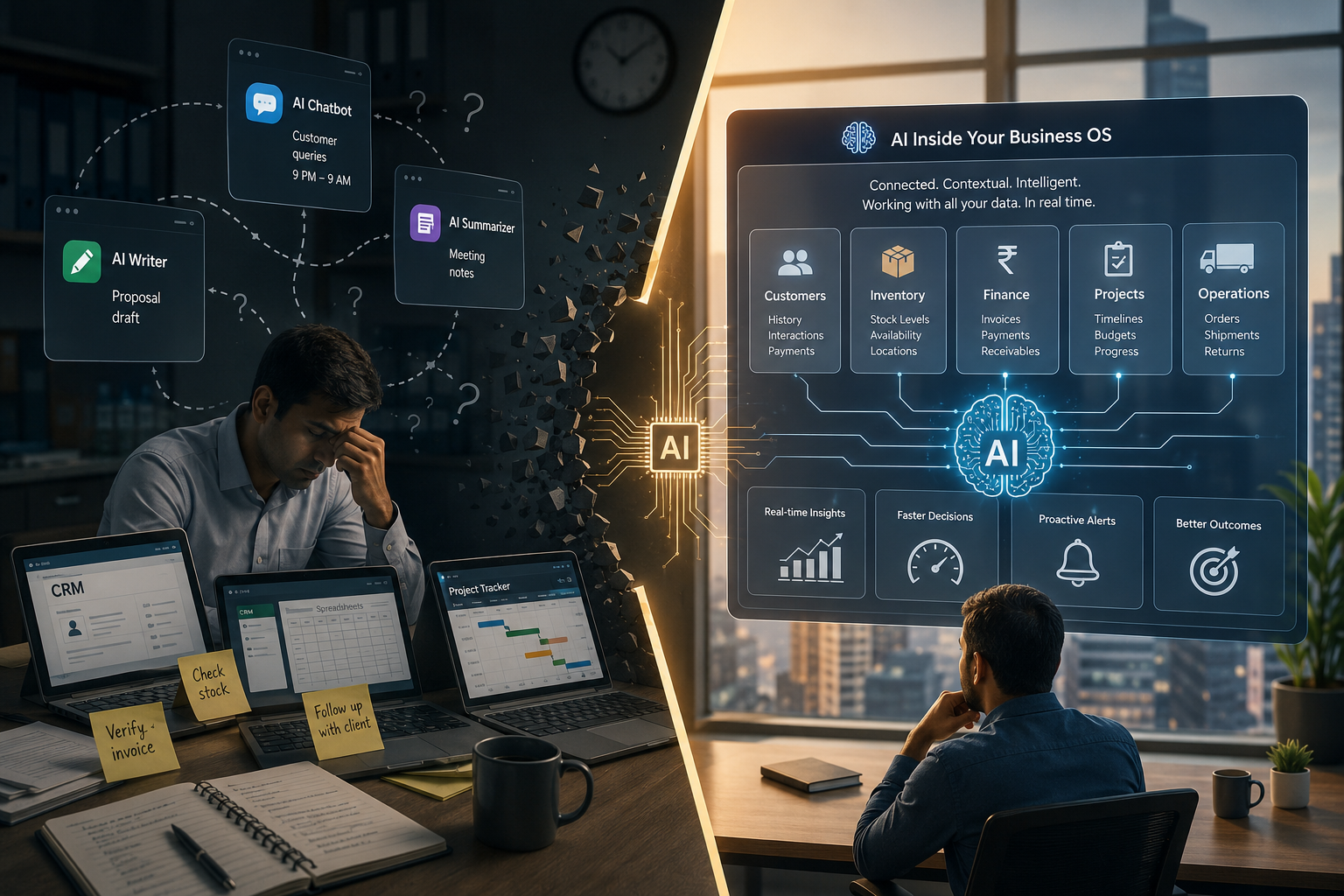
The chatbot answers customer queries between 9 PM and 9 AM. The AI tool writes the first draft of every proposal. Another one summarises meeting notes. Three subscriptions, three logins, three tools doing useful things in complete isolation from the business they are supposed to be helping.
This is how most businesses have adopted AI. One tool at a time, one problem at a time, with no connection between any of them and the system the business actually runs on.
It works. The same way a workaround works. Until the next layer of complexity arrives.
Call it AI at the edges. It is what happens when artificial intelligence is added to a business as a series of point solutions rather than embedded into the operating system of the business itself. Each tool solves a specific problem well. None of them know anything about the others. And none of them have access to the data that would make them genuinely useful — the inventory levels, the open invoices, the project timelines, the customer history that lives inside the business rather than outside it.
A logistics company in Mumbai added an AI tool for customer communication, another for route optimisation, and a third for document processing. Each one worked as advertised. But when a shipment was delayed, the customer communication tool had no visibility into the route data, and the document tool had no connection to either. Three people still had to manually coordinate the information between three systems to resolve a situation that should have been handled automatically. The AI was present. The intelligence was not connected.
Why It Happens
AI adoption in most businesses follows the path of least resistance. A team member discovers a tool that solves an immediate problem. It gets adopted. Then another. Then another. Nobody steps back to ask whether these tools are connected to the business or just connected to individual workflows within it.
There is also a framing problem. Most AI tools are marketed as productivity enhancers for individuals — write faster, summarise quicker, respond sooner. That framing is accurate but limited. It positions AI as something that makes a person more efficient rather than something that makes a business more intelligent.
The distinction matters because individual productivity and business intelligence are not the same thing. A sales person who drafts proposals faster is more productive. A business where the AI drafting the proposal can also see the client’s payment history, outstanding balance, and last three interactions is more intelligent. One is a tool. The other is an operating system.
A professional services firm in Hyderabad had six people using AI tools individually. The partners used one for research and drafting. The accounts team used another for invoice follow-ups. The project managers used a third for status summaries. Each person was measurably faster at their specific task. But the firm’s biggest operational problem — projects running over budget without anyone catching it early enough — was untouched. None of the AI tools had access to the data that would have flagged the problem. They were sitting at the edges of the business, not inside it.
A retail chain in Pune implemented an AI-powered customer support tool that handled queries about orders, returns, and product availability. It handled them well, until a customer asked about a specific item at a specific store. The tool had no connection to the inventory system. It gave a generic answer. The customer went elsewhere. The AI had been given a job to do without being given the information it needed to do it properly.
A manufacturing business in Ahmedabad used AI to generate purchase order drafts based on historical patterns. Useful. But the AI had no visibility into current stock levels, current production schedules, or supplier lead times that had changed since the training data was set. It was generating drafts based on a version of the business that no longer existed. Someone still had to check every recommendation against the actual position before acting on it. The tool saved some time. It did not change how the business made decisions.
The pattern across all three is the same. AI doing useful work at the edges of the business while the core of the business continues to operate on the same information gaps it always had.
Standalone AI tools have a subscription cost that is easy to see. The cost of AI that is not connected to the business is harder to quantify but consistently larger.
Every AI tool that operates without access to live business data is producing outputs that require human verification before they can be acted on. That verification step is the cost. It is the sales person who checks the proposal against the CRM before sending. The operations manager who confirms the purchase order recommendation against the current stock count. The support agent who looks up the actual inventory position the chatbot could not access. These steps exist because the AI is working from incomplete information. They would not exist if the AI were embedded in the system where the complete information lives.
There is also an opportunity cost. Businesses that have embedded AI into their operating systems are making faster decisions, catching problems earlier, and responding to customers with more context. Businesses running AI at the edges are getting faster individuals. The gap between those two outcomes compounds over time.
Standalone AI is a productivity investment. Embedded AI is a business intelligence investment. Most businesses are making the first one while believing they are making the second.
Before adding another AI tool, ask one question.
Does this tool have access to the data my business actually runs on — or is it working from information I have to manually provide every time?
If the answer is the latter, the tool is at the edge. It may still be worth using. But it is not the same thing as AI that is inside the business, connected to the inventory, the financials, the customer records, and the operational data that makes intelligence actually intelligent.
That distinction is worth making before the next subscription gets added.
AI at the edges shows up everywhere but the cost is sharpest in businesses where decisions depend on connected data. Manufacturing, where procurement, production, and dispatch need to operate from the same real-time picture. Retail, where customer service, inventory, and sales are three parts of the same transaction. Professional services, where project delivery, billing, and client history need to be visible together to make good decisions about priorities and pricing.
It is also the central challenge for any business now evaluating AI seriously. The question is not whether AI is useful. That is settled. The question is where in the business it sits. At the edge, it makes individuals faster. Inside the operating system, it makes the business smarter.
Most businesses in 2026 have answered the first question. Very few have answered the second one.
A business where AI can see everything the business knows is a fundamentally different kind of business. Most are not there yet. The ones that are moving in that direction are not buying more tools. They are connecting the ones they have.